Novel Revision Checklist: Seven Passes From Big Picture to Proofread
A novel revision checklist in seven passes, from story and structure down to lines and proofreading, with advice on resting the draft and using beta readers.
On this page
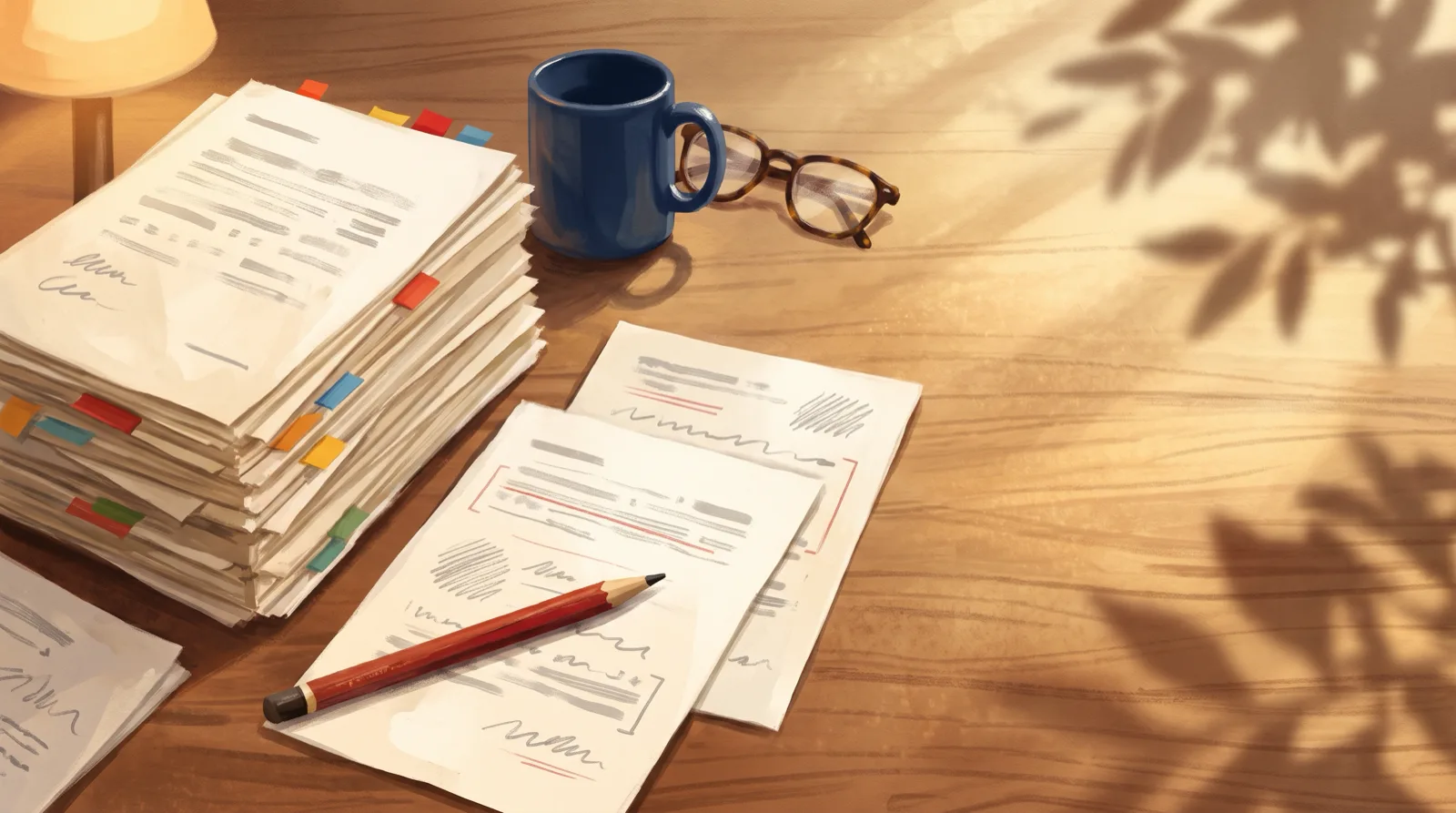
You have a finished draft, and it needs work. That is normal. The difficulty is knowing where to start, because everything seems to need attention at once. This novel revision checklist gives you an order: seven passes that run from the largest questions about the story down to a final proofread, with a short list of things to check in each.
The order matters. There is no point polishing sentences in a scene you will cut next week, or renaming a minor character before you have decided whether the character stays. Work from big to small and each pass makes the next one easier.
Before the first pass: rest the draft
Put the manuscript away before you open it again. How long depends on you and the book, and no honest universal number exists. Some writers wait a couple of weeks; others wait longer. The test is whether you can read your own pages as a stranger would, noticing what is on the page rather than what you meant.
While it rests, do something else: read, write something small, take a walk. Resist rehearsing the draft in your head.
When you come back, change how you read:
- Print it, or move it to another device. A different format makes the text look unfamiliar, and you will see more.
- Read it quickly the first time. Aim to read as a reader would, in a few sittings, and write notes only in the margin or a separate list.
- Read aloud later. Aloud is for sentences and dialogue, not for story questions. Save it for pass six.
- Keep a change log. One line per change, such as "moved the confession from chapter 9 to chapter 7". You will thank yourself during the continuity pass.
The novel revision checklist, pass by pass
Each pass below has one job. Tick the boxes as you go, and when you spot something that belongs to a later pass, note it in the margin rather than fixing it now.
Pass 1: the story
Read the whole book and answer, in plain sentences, what happened and why it matters. If you cannot summarise the book in a paragraph, the problem is here, not in the sentences.
- [ ] Can I state the premise in one sentence: who wants what, and what stands in the way?
- [ ] Does the main character want something at the start, and is that want tested?
- [ ] Do the stakes rise, or do they stay the same from page 50 to page 300?
- [ ] Does the ending answer the question the opening asked?
- [ ] Is anything in the book there only because I liked it?
For a worked example, take a story about a ferry captain who is trying to find out why pages were cut from her late father's logbook. If at the end you realise the logbook matters far less than the quarrel with her nephew, you have found something real: either the nephew's story is the main plot, or the logbook needs to matter more.
Pass 2: the structure
Now look at the shape. Write one line for each chapter saying what changes in it (a reverse outline), then look at the list rather than at the pages.
- [ ] Do the turning points come where the story needs them, or are they bunched at the end?
- [ ] Is the middle only travelling, or does it also reverse something?
- [ ] Are there chapters that could be removed without anyone noticing?
- [ ] Are there two chapters that do the same job and should be merged?
- [ ] Does information arrive in the right order for the reader: no question answered before it matters, no mystery that is simply withheld?
- [ ] Does each side story start, turn and end, and does it touch the main plot at least once?
This is the pass where you move, cut, merge and add whole chapters. It is the cheapest time to do it.
Pass 3: the scenes
Take the scenes one at a time. A scene is a unit of change, and it should earn its place.
- [ ] Does someone want something in this scene?
- [ ] Is there an obstacle, so the want is not met at once?
- [ ] Is the situation different at the end from the start?
- [ ] Do I enter late and leave early, cutting the greeting and the goodbye?
- [ ] Is the point of view clear and consistent?
- [ ] Does the scene use a place and a few concrete details, rather than a stage with nothing on it?
A quick fix for a flat scene: write the first and last line of the scene in the margin. If the two lines describe the same situation, nothing happened.
Pass 4: the people
Read as each important character in turn, tracking only them.
- [ ] Do they want something specific, and does it change as they learn?
- [ ] Do their choices come from who they are, or from what the plot needs?
- [ ] Does the main character change, or at least resist change for a reason we understand?
- [ ] Could I tell who is speaking without the tags?
- [ ] Do the minor characters do more than deliver information?
Try the cover-the-name test on three lines of dialogue. If any of the characters could say any of the lines, the voices need work. How to write dialogue in a novel covers voices in more depth.
Pass 5: continuity
Continuity slips are hard to see because you are reading for story. Give them their own pass, with a list in hand.
- [ ] Names and spellings: the same person is never called two things by accident.
- [ ] Looks and physical details: eye colour, scars, ages.
- [ ] Timeline: days of the week, seasons, how long a journey takes, how old a child should be.
- [ ] Who knows what, and when. A character should not act on something they have not learned yet.
- [ ] Places: the layout of a house, the route between two towns.
- [ ] Setups and payoffs: every promise to the reader (a gun on the wall, a question raised) is answered or deliberately left.
A typical slip: in chapter 3 the harbour master says he never read the logbook; in chapter 14 he quotes a line from it. Either he lied, which could be a gift to the plot, or the line is a mistake. Decide which, and write it in your change log.
Pass 6: the lines
Now the sentences. Because the story is settled, this work will stay.
- [ ] Cut repeated words and phrases, especially the ones you use as tics.
- [ ] Look for filter words that stand between the reader and the moment ("she saw", "he felt", "it seemed").
- [ ] Replace vague words with specific ones.
- [ ] Vary sentence length so a paragraph has some rhythm.
- [ ] Read the dialogue aloud. If you stumble, a reader will too.
A small before and after:
Before: She felt very nervous as she walked slowly toward the dock.
After: The planks complained under her boots, and she counted them to the water.
The first tells you the feeling. The second lets you infer it. You do not need to do this to every line, but read aloud and mark the ones that sag. More pairs are in show don't tell examples.
Pass 7: the proofread
This is the last pass, after the text has stopped changing. The aim is to catch what remains: typos, doubled words, punctuation, formatting.
- [ ] Run spell check, then read anyway. Spell check will not catch "form" for "from" or "there" for "their".
- [ ] Read one line at a time, with the rest of the page covered, or read the book backwards by paragraph.
- [ ] Check dashes, quotation marks and ellipses are consistent.
- [ ] Check chapter headings, numbers and spacing.
- [ ] Choose a style guide, such as the Chicago Manual of Style, or write your own list of choices so the whole book follows them.
A fresh pair of eyes helps most here. If you can swap chapters with another writer, do. When the proofread is done, how to publish a book covers what comes next.
Where beta readers fit
Send the draft to beta readers after you have done passes one to three, when the story is stable but not yet polished. Sending it earlier wastes their time on problems you already know about, and sending it later makes big changes painful.
- Pick a small number of readers who read your genre. A few thoughtful ones are better than many casual ones.
- Ask specific questions. Where did you get bored? Where did you get confused? Which person did you care about least? What did you expect to happen that did not?
- Do not defend the book. Take notes, say thank you, and decide later.
- Look for patterns. Where several readers stumble in the same place, something is wrong there, even if their fixes differ.
How NovelGPT helps with revising your novel
Revision comes down to reading your book as a stranger would and keeping straight everything you have told the reader. NovelGPT supports passes five to seven in its Check section, working from Story memory, which turns each chapter into facts, threads and a summary. Free checks catch name typos, people who appear after they left, tense slips and timeline order, instantly and at no cost. A whole-book consistency check (details here) sorts what it finds into Must fix, Worth a look and Minor, and quotes both passages so you can judge for yourself.
Edits offers nine suggestion passes, from structure and pacing to dialogue and copy edit, and you accept or reject what it proposes. Proofread reads one chapter, the rest of the book or all of it, checking each chapter against the story so far; you can review every change first or have them applied as it goes, and one tap undoes a chapter. More on the AI manuscript editor page.
It is a second reader for the slips, not a replacement for your own read-through, and nothing changes your book unless you allow it.
Try this
If you want something to practise the first two passes on, take this premise, draft a rough chapter list, and then do a reverse outline of it to find the chapter that does nothing.
Frequently asked questions
How many drafts does a novel need?
There is no correct number. What matters is that each pass has a clear job and that you stop when a pass finds nothing worth changing. Most writers find the early passes change a great deal and the later ones change very little.
Should I fix typos as I revise the story?
Fix the ones you trip over, but do not hunt for them yet. Sentences you are about to rewrite or cut do not need a careful proofread. Save that for the final pass, when the text has stopped changing.
How do I know when the revision is finished?
You are finished when a full read-through turns up only small things: a word here, a comma there. If you are still moving scenes or changing what a character wants, you are still in an early pass and should go back to that checklist.
What if my beta readers disagree with each other?
Look for the problem underneath rather than the fix each reader suggests. If two people stumble in the same chapter, something is wrong there even if they propose different cures. If only one person has an issue, weigh it against what you know about your book and your readers.
Sources
Related posts
Do You Italicize Book Titles? The Rules in Chicago, MLA, APA and AP
Do you italicize book titles? Yes in Chicago, MLA and APA; AP uses quotation marks. See the rules for series, chapters, short stories and headings.
Read the post →
How to Write Enemies to Lovers (Without Making It Toxic)
How to write enemies to lovers: build real opposing goals, earn respect before attraction, pace the turn and keep the hostility from turning cruel.
Read the post →
How to Write a Fight Scene That Readers Can Follow
How to write a fight scene: give it a goal and a cost, fix the viewpoint, keep the choreography clear, pace it and show the injury, with examples.
Read the post →