How to Write a Memoir: Find Your Theme and Shape the Story
Learn how to write a memoir: choose a slice of your life, find the theme, pick a structure, build scenes from memory and write about real people with care.
On this page
If you are working out how to write a memoir, the hardest decision comes before the first sentence: which part of your life is this book about? Nobody can fit a whole life into one book, and readers do not want it. They want a stretch of time, a relationship or a turning point, told so that it means something to them.
This guide covers how to choose that slice, find its theme, pick a structure, turn memories into scenes, handle the limits of memory and the people who appear in your pages, and find your voice. It ends with a worked example you can adapt.
Memoir or autobiography: what is the difference?
An autobiography tells the story of a whole life, usually in order, from birth towards the present. Benjamin Franklin's Autobiography, free on Project Gutenberg, is a classic of the form: a public figure setting down how he became who he was.
A memoir is narrower. It takes one slice of a life and treats it the way a novelist treats a plot: with a question, rising pressure and an ending that changes something. Frederick Douglass's Narrative is a famous early example of a life story shaped around a single purpose, the movement from enslavement to freedom, rather than a record of everything that happened.
For you as a writer, the difference is practical:
- An autobiography asks, "What happened?"
- A memoir asks, "What did it mean?"
If you are unsure which you are writing, ask what you want to leave out. If the answer is "most of it", you are writing a memoir.
How to write a memoir: find your theme and the slice of life
Start by choosing the slice. A few useful boundaries:
- A period of time: the year you spent caring for a parent, the summer you lived abroad.
- A relationship: you and a sibling, a teacher, a place.
- A turning point and its aftermath: a diagnosis, a move, a decision you still think about.
- A pursuit: learning a trade, recovering from an injury, raising a child.
Then ask what question the slice answers. This is your theme, and it is what separates a memoir from a diary. "My year in the shop" is a subject. "What I learned about repairing things that cannot be replaced" is a theme.
A quick test: finish the sentence "This book is about ___, and by the end I understand ___." If the second blank is empty, keep digging. The answer can change as you draft; many writers find the real theme only when the same images keep returning.
Choose a structure
A life happens in order, but a book does not have to. These are the three common options.
| Structure | How it works | Suits |
|---|---|---|
| Chronological | Events in the order they happened | A clear arc over a defined period |
| Thematic | Chapters grouped by idea, not date | A life with a recurring thread, such as food, faith or work |
| Braided | Two or more strands alternate, often past and present | A story where a present-day search or crisis lights up the past |
Chronological is the safest and often the best. It carries the reader along and makes cause and effect easy to see. Its risk is a flat "and then, and then" feel, so make sure every chapter changes something.
Thematic gives you freedom to put a memory from age nine beside one from age forty because they rhyme. The risk is looseness; each chapter needs its own question.
Braided works well when you have a present-day frame, such as clearing a family home, with memories entering as the objects are found. The risk is that one strand feels like an interruption. Make each strand earn its place by having it answer a question the other raises.
Whatever you choose, outline first: list the chapters, write one line on what each changes, and check that the order builds. The steps in how to write a novel outline work for a memoir's chapter list too.
Build scenes from memory
Memoir lives or dies on scenes. A summary tells the reader what happened; a scene lets them be there. The goal is not to remember everything, but to render the moments that matter in the present moment of the page. The show don't tell examples are a good model for turning a summary into a scene.
Here is a flat, summarised memory:
The summer my father had his stroke, I took over the repair shop. I was frightened, but I learned to cope, and by autumn I felt more confident.
Now the same material as a scene:
The first customer through the door that Monday wanted her grandmother's watch fixed by Friday. I turned it over in my hands. The back was held on with a tiny screw I'd only ever seen my father touch. "He'll be in soon?" she said. I said yes. My thumb found the groove of the screwdriver before I'd decided to pick it up.
The scene gives you a person, a task, a line of dialogue and one small action that carries the emotion. It does not say "I was frightened". The reader works it out.
To pull scenes out of memory:
- Start with the senses. What did the room smell like? What was the light doing? One concrete detail often opens up three more.
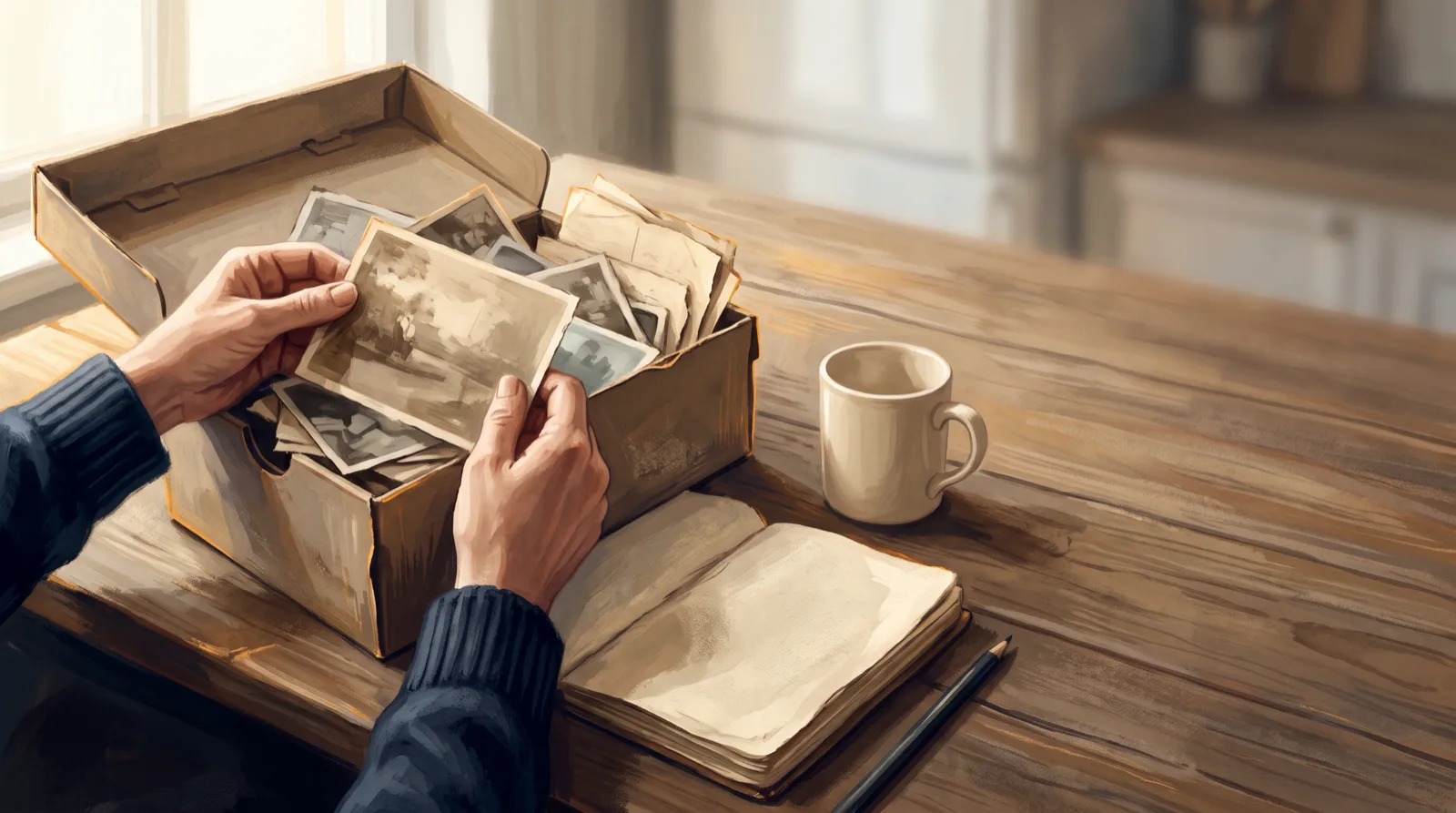
- Anchor to objects and places. Photographs, letters, old maps and receipts jog memory and give you facts to check against.
- Write the scene before you judge it. Get the moment down first. You can fix the details later.
Truth and the limits of memory
Memory is not a recording. You will forget some details, blur others and reconstruct conversations you cannot repeat word for word. Readers of memoir accept this, provided you are honest with them. A few habits help:
- Separate what you know from what you reconstruct. A date from a letter is firm. The exact words your mother said at the door are your best recollection. Keep track of which is which.
- Say so on the page where it matters. A phrase like "as I remember it" or "I can't swear to the words, but the meaning was clear" tells the reader you are being straight.
- Check what can be checked. Dates, places, ages and public events can usually be confirmed. Do it before you build a chapter on them.
- Compress with care. Merging two similar conversations is common, but do not invent events, and say in a note what you compressed.
- Accept that other people remember differently. You are writing your account, not a court record.
An author's note at the front or back, a short page saying how you wrote the book and what you changed, is a simple way to keep the agreement with the reader clear.
Write about real people with care
A memoir has real people in it, and they did not choose to be there. This is both an ethical and a practical question, and it deserves thought early, not at the end.
Some approaches many memoirists find helpful:
- Write the first draft freely, then review it as if you were the person described. Is each portrait fair? Does it show them as a whole person, with reasons and contradictions, or as a villain you needed?
- Ask whether a detail serves the story. If it only wounds someone and does nothing for the theme, consider cutting it.
- Consider changing names or identifying details, and say so in an author's note.
- Consider talking to the people involved, where it is safe and sensible, before the book is out.
A word of caution: this guide is not legal advice. Rules on privacy and on false or damaging statements differ from country to country, and they depend on the details. If your book is about living people, especially about anything sensitive or disputed, talk to a lawyer who works with publishing before you release it.
Find your voice
In memoir the voice is the book. It is the sound of one particular mind looking back, and it should sound like you on a good day. Most memoirs are in first person, but not all; first person vs third person compares the options.
- Write the way you tell the story aloud. Record yourself telling a friend the story, then listen for the phrases that are yours.
- Hold two selves in view. There is the person who lived it and the person who now understands it. The best memoirs let the older narrator comment lightly, while the younger one stays in the scene.
- Be as hard on yourself as on anyone else. Readers trust a narrator who admits mistakes and does not always come out well.
A worked example
Here is a memoir plan built step by step. The writer and the story are invented.
Slice: the year the writer, at seventeen, ran her father's watch-repair shop after his stroke.
Theme question: what is the difference between fixing something and replacing it, in a family as in a shop?
Structure: braided. A present-day thread follows her, decades later, clearing the shop's last drawer. Each object she finds opens a chapter set in that year.
Chapters:
- The drawer: she finds a watch with a tag in her father's hand, a name she does not know.
- The first customer: the grandmother's watch scene above.
- The ward: visiting her father, who cannot say the word "screwdriver" but can still point to it.
- The rule: a customer wants a cheap replacement; her father's old rule was that you never tell someone their watch is not worth fixing.
- The mistake: she damages a watch beyond repair. The scene shows her telling the owner the truth.
- The tag: she tracks down the stranger's name and learns what her father kept for twenty years.
- The drawer again: she closes it, and what she decides to keep.
Notice what the plan does. It picks one slice, states a question, gives every chapter a change, and ends on a choice that answers the theme. It also leaves out her schooling, her later career and her marriage. They are not part of this book.
How NovelGPT helps with writing a memoir
A memoir is built from your memories, and an AI has none. NovelGPT only works from what you give it, and the writer stays in charge of every fact and every line. Writing by hand is always free.
You can start from a sentence or the Memoir Quick start, or import what you have already written in a Word, text or PDF file; NovelGPT finds the chapters and you check the splits. People hold the real people in your story, with their history and how they speak. The Timeline lets you put real events in order with the people and places involved. Notes keep the evidence behind a chapter, and each note carries a reliability badge (verified, likely, uncertain or unverified), so a diary entry and a half-remembered story do not look the same.
The Chapter plan gives each chapter a purpose, and the Book map shows the whole book at a glance. In the editor, Write with AI can draft from your notes, and every AI result arrives as a proposal you accept or reject; every AI action shows a credit estimate first.
The AI memoir writer page explains how the pieces fit together, and the AI novel writer overview covers the rest. Whatever you use, the test is the same: does each chapter show a moment you remember, in a voice that is yours, and does it move you closer to the answer your theme asks for?
Frequently asked questions
How long should a memoir be?
There is no fixed rule. A memoir is usually shorter than a whole-life autobiography, and a focused book can work well at modest length. Let the slice of life you chose decide the length, not a target.
Do I need to have lived an extraordinary life?
No. Readers come to a memoir for the quality of the telling and the insight, not for the size of the events. A quiet year examined honestly can make a stronger book than a dramatic decade told as a list.
What if my memory of an event is different from someone else's?
That is normal, and you do not have to settle it. Write what you remember, say so where it matters, and consider asking the other person for their version. You can note the difference in the text or in an author's note.
Can I change names and details?
Many memoirists change names or small identifying details and say so in an author's note. That is a courtesy, not a legal shield. If you are worried about how a real person is portrayed, ask a publishing lawyer who knows the law where you live.
Sources
Related posts
How to Write Enemies to Lovers (Without Making It Toxic)
How to write enemies to lovers: build real opposing goals, earn respect before attraction, pace the turn and keep the hostility from turning cruel.
Read the post →
How to Write a Horror Novel: Dread, Monsters and Pacing
How to write a horror novel that frightens: pick your kind of fear, build dread slowly, keep the monster half-seen and pace your scares.
Read the post →
How to Write a Fantasy Novel: Plot, Magic Costs and Pacing
How to write a fantasy novel: choose a subgenre, build a plot around a want, price your magic, pace the quest and keep a big cast clear.
Read the post →